
If you are wondering How to Choose a Curcumin Supplement you are not alone. When you go to a shop or type curcumin supplements in a search bar you will see products that vary in strength, ingredients, formulas and claims. Picking the one can become confusing fast.
The good news is that you do not have to be a supplement expert to make a decision. By learning what curcumin is reading the label seeing the form of curcumin used, understanding absorption and focusing on quality and safety you can compare products with confidence.
Curcumin is a compound that lives in turmeric. Turmeric comes from the plant Curcuma longa and curcuminoids — including curcumin — give turmeric its color. Curcumin has been studied for its anti‑inflammatory effects. Human research is still growing and results differ with each condition and formula.
This guide explains what to look for when selecting a curcumin supplement. It does not promise results from any supplement.
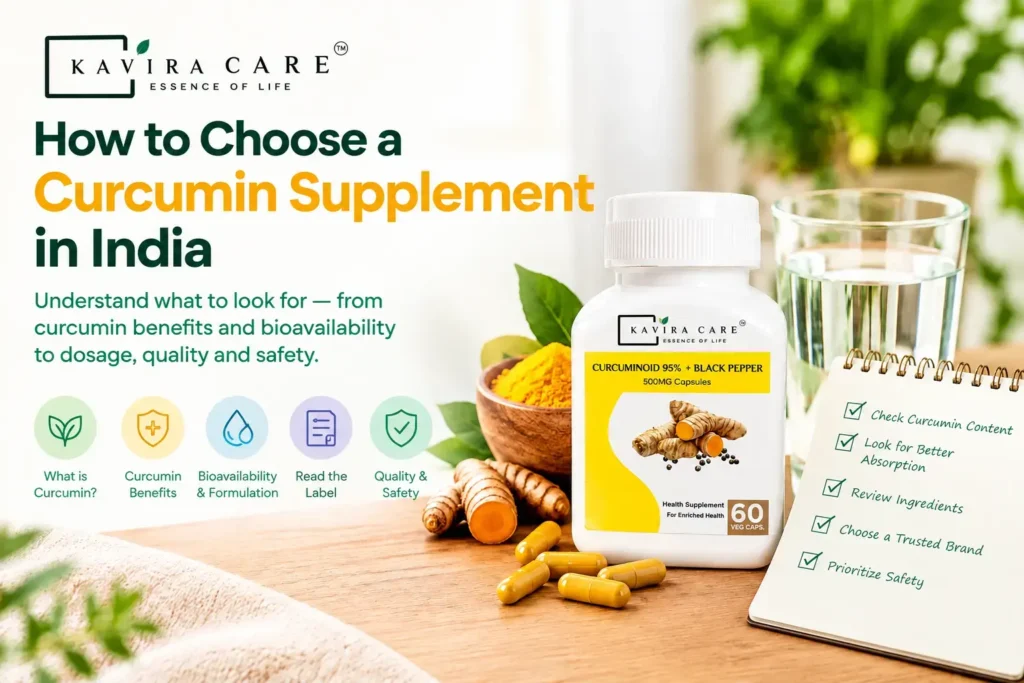
What Is Curcumin?
Before learning How to Choose a Curcumin Supplement it helps to understand the ingredient itself.
Curcumin is a compound that lives in turmeric. It belongs to a family of compounds called curcuminoids. Turmeric has been used for a time, in other Asian cultures both as a spice and in traditional health practices.
Curcumin has attracted interest because laboratory and human studies have looked at its effects on inflammation, oxidative stress, joint pain and other health areas. However, turmeric and curcumin are not exactly the same.
Turmeric is the spice or plant material. Curcumin is a compound that lives in turmeric. A turmeric supplement may contain powder or extract while a curcumin supplement may give a concentrated extract.
Understanding this difference is one of the steps in learning How to Choose a Curcumin Supplement.
Curcumin Benefits: What Does the Research Say?
People often search for curcumin benefits when thinking about a supplement. Research has looked at curcumin for health areas. It is important to separate hopeful evidence from proven medical effects.
Some studies have looked at curcumin for discomfort osteoarthritis symptoms. NCCIH reports that early evidence from studies is positive for measures such as knee pain and stiffness but better research is still needed before firm conclusions can be made.
Researchers have also studied curcumin because of its antioxidant and anti‑inflammatory activity. Some clinical studies have seen changes in oxidative‑stress markers. However, these findings do not automatically mean that a curcumin supplement can prevent or treat a disease.
This is why a responsible supplement guide should focus on evidence, product quality and realistic expectations of promising guaranteed health results.
How to Choose a Curcumin Supplement?
When comparing products do not pick a supplement just because the bottle lists the number of milligrams.
Instead look at factors together.
1. Check the Curcumin or Curcuminoid Content The first thing to check is the Supplement Facts or nutrition label.
Look for information about:
- Turmeric extract
- Curcuminoids
- Curcumin
- Standardised extract
- Ingredients.
A label that clearly tells you what you are getting is easier to evaluate than one that simply says ” blend” without details. Remember that a larger number on the front of a bottle does not automatically mean a product. The amount of powder and the amount of curcuminoids are not necessarily the same.
Why the Label Matters
Two products may both contain 500 mg of extract. Have different amounts of curcuminoids. That is why looking at the ingredient information is more useful than comparing the headline milligram number.
Understand Curcumin Bioavailability
One of the challenges with curcumin is its relatively low bioavailability. Bioavailability means, in terms how much of a substance becomes available to the body after it is consumed. Curcumin has traditionally been considered absorbed which has led researchers and manufacturers to explore different formulations designed to improve absorption.
When learning How to Choose a Curcumin Supplement therefore do not look at the amount of curcumin. Pay attention to the formulation and the information about absorption.
What Does Bioavailability Mean?
A supplement with a formulation is not automatically the choice, for everyone. Some curcumin formulations mix curcumin with ingredients such, as piperine while other curcumin products use delivery technologies.
Research shows that piperine can raise curcumin exposure. The clinical importance of curcumin bioavailability is still not fully known. I think this shows that more research is needed.
1. Look at the Formulation
curcumin supplements may use forms or delivery systems. I notice that each curcumin supplement is different.
You may see terms such as:
- Curcumin extract
- Curcuminoid extract
- Curcumin with piperine
- Enhanced‑bioavailability curcumin
- Phytosomal formulations
- Micellar or other delivery systems
Do not assume that one curcumin formulation is automatically the best for every person.
A 2024 methodological review found that many systematic reviews did not fully account for differences in curcumin bioavailability when combining evidence from studies. This means that the exact curcumin formulation matters when interpreting research. I realize that the curcumin formulation is important.
2. Check Whether Piperine Is Included
Piperine is a compound that comes from pepper.
It is often added to curcumin supplements because research suggests that piperine can raise curcumin bioavailability. I have seen that piperine is often added.
However more curcumin absorption is not automatically better for every individual.
Piperine and other ingredients can potentially change how substances are absorbed or metabolised. If you take prescription medicines talk with a healthcare before using a supplement that contains piperine or any other absorption‑enhancing ingredient.
3. Avoid Choosing a Product Because of a High Dose
A mistake is assuming:
Higher dose = better supplement.
That is not necessarily true.
Clinical studies have used curcumin formulations and doses so there is no number that can be described as the ideal dose for everyone.
Your choice should depend on the product formulation, label directions, your circumstances and professional advice where appropriate. I choose supplements based on these factors.
4. Check the Full Ingredient List
A good supplement label should make it clear what the product contains.
Before buying a curcumin supplement check:
- Ingredients
- Amount per serving
- Serving size
- Other ingredients
- Allergens if applicable
- Manufacturer information
- Storage instructions
- Batch or quality information where available
Be especially cautious about products that make promises such as guaranteed disease prevention, instant results or “miracle” effects. I am wary of claims.
5. Look for Transparent Quality Information
Quality matters because the curcumin supplement you buy may not be the same as the product used in a study. I make sure the curcumin supplement is quality.
NCCIH points out that supplements available commercially can differ from products tested in research.
When comparing products look for a manufacturer that provides information about:
- Ingredient identity
- Ingredient amounts
- Manufacturing standards
- Testing or quality‑control processes
- Batch information where applicable
- Contact information
Transparency makes it easier for consumers to understand what they are buying.
6. Consider the Purpose of the Supplement
Ask yourself why you are considering curcumin.
- Are you looking for support?
- Are you interested in research surrounding health?
- Are you simply exploring turmeric‑based supplements?
I think the purpose matters.
Your reason matters because evidence differs across health conditions.
For example NCCIH states that there is not evidence to definitively conclude that oral turmeric or curcumin is beneficial for every condition for which it is marketed.
A supplement should not replace diagnosis or treatment.
7. Compare Products Using the Same Criteria of asking
“What is the best curcumin supplement in India?”
make your comparison more specific.
For each product compare:
- Curcuminoid content
- Formulation
- Bioavailability information
- Additional ingredients
- Label transparency
- Quality‑control information
- Serving instructions
- Manufacturer reputation
- Price per serving
- Safety considerations
This approach helps you make a comparison rather than choosing based only on advertising. I compare carefully.
How to Choose a Curcumin Supplement in India
If you are searching for the best curcumin supplement in India the same basic principles apply. I follow these principles.
Look beyond the marketing on the front of the package. Read the label. Understand what the product actually provides. I always read the label.
Indian consumers may find products ranging from powder, to concentrated curcumin extracts and enhanced‑bioavailability formulations.
The right comparison is therefore not Which brand has the strength?”
Instead ask:
What form of curcumin does the product contain, how much does each serving provide what other ingredients are included and how clearly does the manufacturer explain the formulation?
Price matters. A cheaper bottle may have servings while an expensive bottle may use a different recipe or serving size. Compare cost per serving, not bottle price.
Best Curcumin Supplement, in India: What Should You Look For?
There is no answer to which product’s the best curcumin supplement in India because individual needs, formulations, preferences and safety considerations differ.
Of relying on a “label use a checklist.
A checklist A curcumin supplement may deserve attention if it shows:
- Clear ingredient list
- Clear curcuminoid amount
- Clear serving size
- Clear formulation details
- Reliable factory info
- Clear use instructions
- No exaggerated health claims
- Clear contact details
- Clear safety warnings
The goal is not to pick the product with the ingredient list. The goal is to know what you are really buying.
Curcumin Supplement Safety
Safety should always be part of the decision.
Conventional oral turmeric recipes are usually safe for people when used in the amounts for short times but side effects can be nausea, stomach upset acid reflux, diarrhoea or constipation.
Importantly turmeric or curcumin products that are very easy for the body to use have been linked to liver injury. The NIH Liver-Tox database lists some reports of liver injury, from a turmeric product though such cases are rare.
This shows why natural does not always mean risk‑free.
If you feel fatigue, low appetite, dark urine or yellow skin or eyes after taking a curcumin product stop using it and get help.
If you use prescription medicine have a health condition are pregnant are breastfeeding or plan surgery talk with a health professional before starting a curcumin supplement.
Conclusions
How to Choose a Curcumin Supplement Learning how to pick a curcumin supplement does not have to be hard. First understand the difference between turmeric and curcumin. Then read the label closely. Look at the amount understand the formula consider how well it is absorbed check extra ingredients and look for clear quality data. Importantly do not judge a supplement by its dose, price, packaging or marketing claims.
The research, on curcumin keeps growing. Some areas show results while other uses still have mixed evidence.
Kavira Care believes that better supplement choices start with information. The more you learn about an ingredient and the product that holds it the confidently you can make decisions that fit your health routine.
FAQs
1. What is curcumin?
Curcumin is a compound that comes from turmeric. Curcumin is one of the curcuminoids found in turmeric.
2. What are the main curcumin benefits?
Research has looked at curcumin for uses, such, as easing problems and reducing signs of inflammation and oxidative stress. The evidence differs for each condition and for formulas so curcumin should not be seen as a guaranteed cure.
3. Is curcumin the same as turmeric?
No. Turmeric is a spice that comes from a plant while curcumin is one of the compounds in that spice. Turmeric contains parts, including curcuminoids.
4. What is a Curcumin herbal supplement?
A curcumin herbal supplement is a product that contains curcumin or a concentrated curcuminoid extract. It may also include other ingredients that help the body absorb it.
5. How do I choose a Curcumin extract supplement?
Look at the amount the formula, the serving size, extra ingredients, quality data how open the producer is and any safety notes of picking the one with the highest milligram count.
6. What is curcumin bioavailability?
Bioavailability means how much of a substance the body can use after you take it. Curcumin has bioavailability, which is why many formulas were made to help it be absorbed better.
7. Is curcumin with pepper better?
Black pepper contains piperine, which can raise curcumin bioavailability. Higher absorption does not automatically mean a product is right for everyone those on medication.
8. How curcumin should I take?
There is no dose that fits everyone. Different studies use formulas and amounts. Follow the product instructions. Get help when needed.
9. Can I take curcumin every day?
Whether you can use curcumin daily depends on the product, dose, formula and your own situation. Term or dose use should be discussed with a healthcare professional.
10. Does curcumin help with health?
Some research shows improvement in pain and stiffness for osteoarthritis. The National Center for Complementary and Integrative Health says that higher quality evidence is still needed.
11. Is turmeric better than curcumin?
They are not the same. Turmeric contains curcumin and other compounds while a curcumin supplement usually gives a dose of curcuminoids.
12. What should I check on a curcumin label?
Read the ingredient name, amount, serving size, other ingredients, formula, maker information, directions and warnings.
13. Can curcumin supplements have side effects?
Yes. Some people may feel stomach upset, nausea, acid reflux, diarrhea or constipation. Some absorbed formulas have also been linked to liver injury.
14. Who should speak to a doctor before taking curcumin?
People who take medicine people with health conditions, pregnant or breastfeeding people and those getting ready for surgery should talk to a healthcare professional.
15. What is the best Curcumin capsules in India?
There is no product that’s best for everyone. Compare the formula, curcuminoid amount, quality data, ingredients, serving size, openness and safety before picking one.